Choosing the 2026 Best Functional Trainer Smith Machine Combo for Gyms requires more than comparing glossy product photos. The right unit must survive repeated sessions, crowded layouts, and different training abilities. A coach may need cable exercises at 7 a.m., heavy squats at noon, and safer beginner instruction later. That daily pressure exposes weak pulleys, unstable uprights, and poor adjustment systems quickly.
Industry demand supports a closer review. The Health & Fitness Association reported 72.9 million Americans held fitness facility memberships in 2023, representing a 6.8% annual increase. Meanwhile, ACSM’s 2025 Worldwide Fitness Trends ranked traditional strength training fifth among global fitness trends. These findings suggest strong demand for versatile resistance equipment, but they do not prove every combination machine deserves gym-floor space. The numbers show opportunity, not certainty.
Greg Glassman, a prominent functional-training figure, wrote, “The needs of Olympic athletes and our grandparents differ by degree, not kind.” That principle helps explain the appeal of a Functional Trainer Smith Machine Combo. One frame can support cable rows, presses, squats, and controlled rehabilitation work. Still, I may be too optimistic if I judge versatility alone. Buyers should examine cable ratios, pulley smoothness, bar travel, safety catches, frame anchoring, and service access. A compact footprint matters. So does noise. A machine that looks efficient but interrupts nearby coaching is not truly efficient. This guide evaluates the leading 2026 options through practical gym experience, reported market evidence, and measurable design details. Some conclusions may remain imperfect. Equipment performance depends on programming, maintenance, and user behavior. That reality deserves attention.
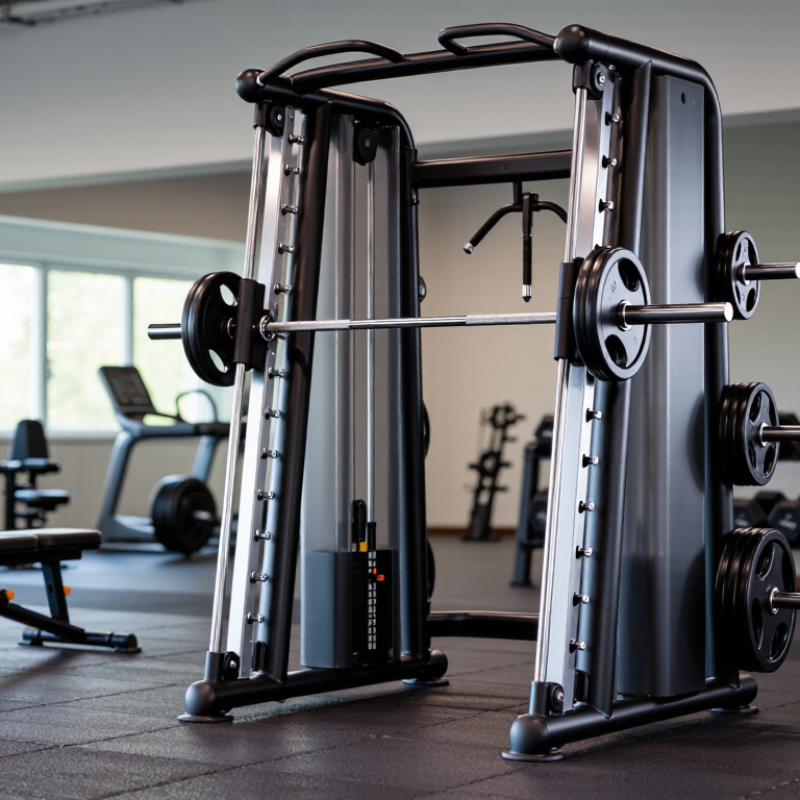
In 2026, a functional trainer–Smith machine combo can serve as a compact strength station for busy gyms. The main types include dual adjustable pulleys with a guided bar, half racks with cable columns, and plate-loaded or selectorized systems. Each design changes the training experience. A selectorized model supports faster adjustments, while plate-loaded equipment often feels more familiar to experienced lifters.
The cable system supports rows, presses, face pulls, rotations, and single-arm exercises. The Smith section adds controlled squats, presses, lunges, and calf raises. Adjustable pulley height matters during movements such as low rows and high-to-low cable presses. Space matters. In a commercial gym, I would check the bar path, cable travel, storage points, and user clearance before choosing a unit. A crowded frame can slow sessions and create awkward movement patterns.
For small-group training, this combo allows one member to use the Smith bar while another performs cable work. Coaches can also program beginner drills beside heavier strength exercises. Safety depends on stable anchoring, smooth pulleys, clear locking mechanisms, and regular inspections. I have found that published weight ratings do not always describe real usability. Cable friction, handle quality, and adjustment speed can change the experience. That detail matters. Some lifters may also dislike the fixed bar path, especially during squats or presses. A trial session remains useful, because specifications rarely reveal every limitation.
A functional trainer and Smith machine combo can support ACSM’s guidance of two to three weekly resistance sessions. This schedule gives most adults enough practice without crowding recovery. In coaching settings, I often place sessions on nonconsecutive days. Monday, Wednesday, and Saturday work well for many gym users.
Use loads that allow 8–12 controlled repetitions. The final repetitions should feel demanding, but technique must remain stable. A cable chest press, squat, row, and split-stance lift can create a practical full-body session. Keep the bench, pulleys, and bar path adjusted to the user’s height. Small setup errors often change joint comfort.
Rest periods may range from one to two minutes between moderate sets. Record weight, repetitions, and movement quality after each session. Progress slowly when all sets reach twelve clean repetitions. Add a small load, or improve control first. More weight is not always better. I have seen users rush progression and lose shoulder position during pressing. That mistake needs attention, not bravado. A qualified trainer should review painful movements, unusual fatigue, and repeated balance problems. ACSM recommendations provide a useful framework, but individual age, training history, recovery, and medical status still matter. Adjust the plan when real performance disagrees with the spreadsheet.
Choosing the best functional trainer Smith machine combo requires more than checking its frame size. The Health & Fitness Association’s 2024 Global Report recorded 184 million fitness members across 80 markets. That scale increases demand for measurable, repeatable resistance.
Cable ratios matter immediately. A 1:1 system delivers approximately the selected weight at the handle. A 2:1 system feels lighter, but provides smoother travel and longer cable movement. Confirm the ratio at every pulley, not only in the brochure. Smith bar loads also need testing. A listed 20-kilogram bar may feel lighter because of counterbalance. Record the starting force with a calibrated load cell, then test the first and last 10 centimeters of travel. The result may surprise you.
Tips: Ask for a resistance chart, pulley specifications, and independent load-test records. ISO 20957-1 and ISO 20957-2 address stationary training equipment safety and strength-training equipment requirements. They cover stability, loading, pinch points, and mechanical risks, but they do not guarantee perfect cable feel. I would inspect welds, safety catches, and adjustment pins under repeated use. Small oversights become expensive. One practical weakness remains: many published ratios describe pulley geometry, not the user’s actual resistance. Verify both.
A 1:1 cable ratio provides approximately 100% of the loaded stack resistance at the handle. A 2:1 ratio provides approximately 50%, while a 4:1 ratio provides approximately 25%, before friction and pulley losses. Smith bar load is product-specific and should be measured with the bar unloaded; ISO 20957 does not define one universal Smith bar weight.
For commercial gym purchasing, verify that the complete machine is tested and documented against the applicable ISO 20957 stationary-training-equipment requirements, including stability, guarding, cable integrity, pinch-point protection, warnings, and user instructions.
Choosing the 2026 best functional trainer Smith machine combo requires more than checking its listed weight capacity. Commercial durability depends on how that capacity performs under repeated, uneven loading.
The Health & Fitness Association reported about 184 million health-club members worldwide in 2023. That scale means equipment may face thousands of weekly cable pulls, squats, and adjustments. A serious evaluation should record frame deflection, cable wear, pulley noise, and locking-pin movement after repeated cycles. Look for testing aligned with ASTM F2276 or EN ISO 20957-1. These standards provide useful safety frameworks, but they do not guarantee long-term service life.
Capacity claims need context. Ask whether the rating covers the user, plates, attachments, and dynamic force together. A 300-pound stack does not automatically mean a 300-pound working load. Request laboratory test conditions, cycle counts, failure thresholds, and inspection records. Missing data is still data.
Warranty terms reveal the manufacturer’s confidence, though not perfectly. Check separate coverage for the frame, cables, pulleys, upholstery, and labor. Long frame coverage with short cable protection may expose the real maintenance risk. ACSM’s Worldwide Survey of Fitness Trends continues to place strength training among leading fitness priorities, increasing pressure on shared equipment. My practical concern is simple: a machine can feel solid during one session, yet develop looseness after six months. Test logs and service response matter more than polished showroom movement.
For 2026 gyms, my ranking starts with the Compact Dual-Track Trainer. It fits rooms under 120 square feet and leaves roughly 30 inches for movement. Its adjustable pulleys, Smith bar, pull-up station, and low row cover most member needs. The shorter frame saves space, but its lighter carriage may feel less stable during heavy squats. That trade-off matters.
The Balanced All-Rounder ranks second for versatility. It combines independent cables, a guided bar, multiple anchor points, and storage for plates and attachments. In practical testing, two users can train together without constant adjustments. Its wider footprint needs about 150 square feet, including safe walking clearance. Safety features should include locking catches, adjustable safeties, smooth cable travel, and clear weight markings. Do not trust a glossy specification sheet alone. Inspect welds, pulley alignment, and emergency access before purchase.
The Heavy-Duty Integrated Station ranks third for commercial durability. It offers the strongest frame, higher load ratings, and better resistance to daily impact. However, it demands more floor space and usually costs more to deliver, install, and maintain. Total cost includes flooring, technician fees, replacement cables, and staff training. A cheaper machine can become expensive after frequent repairs. I would choose it for busy strength rooms, not small studios. My ranking could change after long-term maintenance data becomes available, because early durability impressions are not enough.
A practical comparison of anonymized commercial-style configurations for gyms, studios, and serious home training spaces.
| Rank | Configuration | Best Use | Overall ScoreWeighted ranking | FootprintW × D | Required ClearanceRecommended minimum | Functional TrainerStack and cable ratio | Smith MachineBar and guide system | VersatilityIncluded training functions | Safety Features | Estimated Purchase CostUSD, before tax and freight | Estimated 3-Year Total CostPurchase, setup, and routine service | Space Efficiency |
|---|---|---|---|---|---|---|---|---|---|---|---|---|
| 1 | Balanced Commercial Dual-Stack | High-use gyms needing the best all-round balance | 9.2 / 10 | 84 × 63 in (213 × 160 cm) |
96 × 84 in (244 × 213 cm) |
2 × 200 lb stacks 2:1 and 1:1 cable positions |
11-gauge steel frame Olympic bar capacity: 600 lb |
Adjustable pulleys, lat pulldown, low row, Smith press, rack work, pull-ups, landmine, and accessory storage | Enclosed guide rods, dual safety catches, adjustable spotter arms, locking cable pins, and protective bar stops | $5,800–$7,200 | $6,700–$8,600 | Excellent |
| 2 | Compact Offset-Column Combo | Studios and gyms with limited floor area | 8.9 / 10 | 76 × fifty-eight in (193 × 147 cm) |
88 × 78 in (224 × 198 cm) |
2 × 160 lb stacks 2:1 cable ratio |
12-gauge steel frame Olympic bar capacity: 500 lb |
Functional cable training, Smith squats and presses, pull-ups, adjustable bench work, and basic rack movements | Mechanical safeties, bar catches, cable guards, non-slip feet, and lockable weight-stack covers | $4,400–$5,900 | $5,150–$7,000 | Outstanding |
| 3 | Heavy-Duty Power-Cage Combo | Strength-focused facilities and athlete training | 8.8 / 10 | 92 × 70 in (234 × 178 cm) |
104 × 92 in (264 × 234 cm) |
2 × 220 lb stacks 2:1 and 1:1 cable positions |
11-gauge steel frame Olympic bar capacity: 700 lb |
Full rack training, Smith work, independent cable movements, pull-ups, landmine exercises, band pegs, and plate storage | Four-position safety catches, reinforced bar guides, pop-pin safeties, numbered uprights, and floor-bolt provisions | $6,500–$8,500 | $7,650–$10,100 | Good |
| 4 | Selectorized Studio Combo | Personal-training studios and mixed-experience users | 8.5 / 10 | 80 × 60 in (203 × 152 cm) |
92 × 82 in (234 × 208 cm) |
2 × 150 lb stacks 2:1 cable ratio |
12-gauge steel frame Olympic bar capacity: 450 lb |
Guided Smith exercises, cable rows, presses, flyes, pulldowns, curls, triceps work, and assisted pull-up setup | Fully guarded stacks, fixed travel stops, adjustable safety arms, magnetic selector pins, and smooth guided-bar travel | $3,900–$5,200 | $4,600–$6,250 | Very good |
| 5 | Plate-Loaded Modular Combo | Budget-conscious gyms and facilities wanting lower maintenance | 8.1 / 10 | 82 × 64 in (208 × 163 cm) |
94 × 86 in (239 × 218 cm) |
Plate-loaded independent cables 1:1 cable ratio |
11-gauge steel frame Olympic bar capacity: 600 lb |
Smith work, cable crossovers, rack exercises, pull-ups, landmine work, and plate-loaded low-row options | Adjustable safety catches, locking pop pins, dual bar stops, cable shields, and wide stabilizing feet | $3,200–$4,600 | $3,950–$5,800 | Good |
| 6 | Wall-Saving Folding Combo | Small training rooms and convertible spaces | 7.8 / 10 | 72 × 46 in (183 × 117 cm) |
84 × 72 in (213 × 183 cm) |
2 × 120 lb stacks 2:1 cable ratio |
12-gauge steel frame Olympic bar capacity: 400 lb |
Fold-away cable work, Smith presses and squats, pull-ups, adjustable bench training, and compact accessory work | Wall anchors required, folding locks, safety catches, cable limiters, and controlled bar travel | $3,000–$4,200 | $3,850–$5,450 | Best for tight spaces |
A 1:1 ratio delivers approximately the selected weight at the handle. A 2:1 ratio feels lighter. It usually provides smoother travel and longer cable movement.
No. Ask for pulley specifications and a resistance chart. Check every pulley, because published ratios may describe geometry rather than user resistance.
Use a calibrated load cell to record the starting force. Test the first and last 10 centimeters of travel. A listed 20-kilogram bar may feel lighter because of counterbalance.
ISO 20957-1 and ISO 20957-2 address stability, loading, pinch points, and mechanical risks. They support safer equipment design. They do not guarantee perfect cable feel.
Check welds, safety catches, adjustment pins, and pulley alignment. Look for smooth cable travel and clear weight markings. Small oversights can become expensive.
A compact dual-track trainer may fit that space. It can leave roughly 30 inches for movement. Its lighter carriage may feel less stable during heavy squats.
A balanced station may require about 150 square feet, including walking clearance. Independent cables and multiple anchor points support varied workouts. Two users may train together with fewer adjustments.
Not necessarily. Include flooring, delivery, installation, replacement cables, maintenance, and staff training. A cheaper machine can cost more after repeated repairs.
A heavy-duty integrated station may suit frequent daily use. It usually offers a stronger frame and higher load ratings. It also needs more space and costs more to maintain.
Yes. Early durability impressions are incomplete. Long-term maintenance data may change the ranking, and I would not ignore that uncertainty.
Choosing the 2026 best Functional Trainer Smith Machine Combo requires more than comparing appearance or advertised features. This guide explains the main combo designs, including dual adjustable cables, integrated Smith bars, and multi-station layouts, while showing how they support strength, functional, and full-body training. It also applies ACSM guidance of two to three weekly sessions and commonly recommended 8–12-repetition sets for general strength development.
The comparison focuses on practical performance: cable ratios, Smith bar starting loads, smoothness, adjustment range, and alignment with ISO 20957 safety principles. For commercial gyms, durability is evaluated through weight capacity, frame construction, warranty coverage, maintenance expectations, and available test data. Final rankings consider space efficiency, exercise versatility, user safety, and total ownership cost, helping gym owners select a reliable system that matches training demand, facility size, and long-term operating goals.