Choosing the right Commercial Cardio Machines requires more than comparing prices or reading polished product brochures. Global buyers must examine performance, safety, durability, service support, and long-term operating costs. A treadmill designed for a busy hotel gym may not suit a rehabilitation center or university fitness facility.
This guide highlights ten commercial-grade machines commonly considered by international purchasers. Each option is reviewed through practical criteria, including motor capacity, frame stability, user comfort, noise levels, energy requirements, and maintenance access. Details matter. A treadmill’s belt should remain steady during repeated sprints, while an elliptical should feel smooth under different user heights. A bike should resist daily wear without creating uncomfortable pressure points.
Regional conditions also deserve attention. Voltage compatibility, certification requirements, shipping protection, replacement-part availability, and technician coverage can strongly influence the final investment. A lower purchase price may become expensive when a control board takes months to replace. That happens.
The selection process also reflects real facility experience, not only manufacturer claims. Product specifications can look impressive, yet busy gyms reveal weaknesses through loose pedals, worn upholstery, or frequent software errors. No ranking can fit every market perfectly. That limitation matters.
By comparing these ten machines from a buyer’s perspective, readers can identify suitable equipment for commercial gyms, hotels, residential developments, sports clubs, and wellness centers. The goal is not to promote one universal winner. It is to support better decisions, clearer supplier conversations, and safer fitness environments across different regions.
Commercial cardio means equipment built for frequent, shared use, not occasional home workouts.
For global buyers, the useful question is simple: can ten machine types help members reach the WHO activity target safely and consistently?
The WHO recommends
150–300 minutes
of moderate activity weekly, or 75–150 minutes of vigorous activity.
A practical reference
That equals roughly 30 minutes on five days.
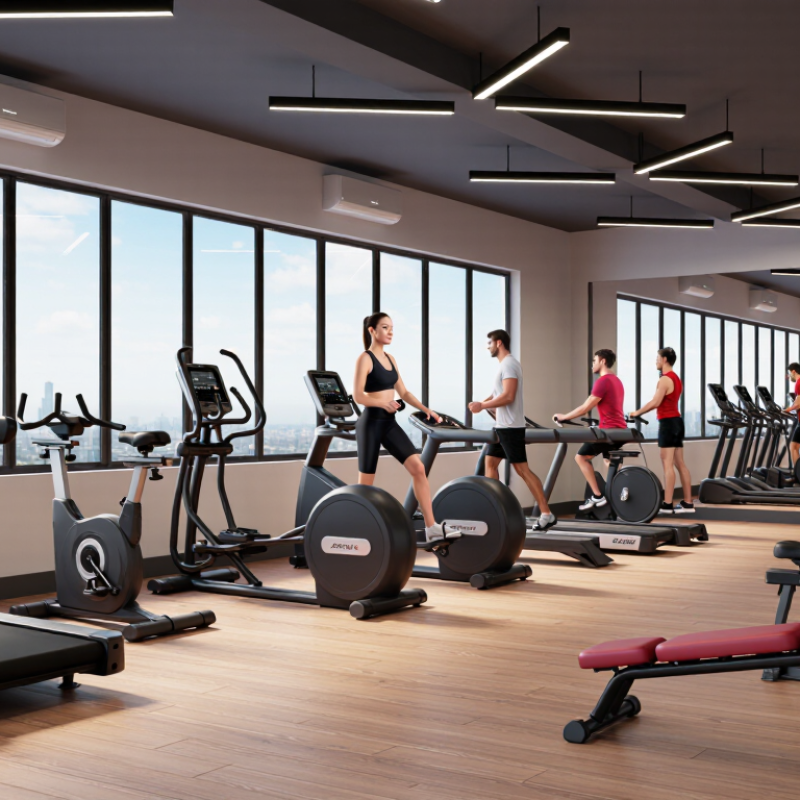
A commercial range may include treadmills, upright bikes, recumbent bikes, ellipticals, stair climbers, rowing machines, indoor cycles, air bikes, ski ergs, and upper-body ergometers.
Each machine creates a different experience.
A treadmill supports brisk walking and running.
A recumbent bike suits users needing back support.
A rower trains many muscle groups, but poor technique can reduce its value.
Facility operators should check
These details matter during crowded morning sessions. Data screens can display time, distance, heart rate, and calories, helping users track weekly minutes.
However, calorie estimates are not perfectly reliable.
Heart-rate sensors also lose accuracy when hands are dry or movement is vigorous. Use them as guides, not medical measurements.
A practical layout offers different intensity levels.
Short sessions count. Realistically, some members will miss their targets. That is normal.
Staff should encourage gradual progress, clear instructions, and comfortable pacing rather than unrealistic promises.
A durable machine is helpful, but consistent use remains the harder part.
Top 10 Commercial Cardio Machines for Global Buyers?
Global buyers comparing commercial treadmills should rank measurable performance, not headline claims. Record top speed in both km/h and mph, then check whether the unit maintains pace during sustained use. A high maximum speed matters less if the deck feels unstable during a trial. Compare incline range and adjustment steps for repeatable training. Measure usable belt width and length, not the outer frame. Taller users need room for longer strides.
Treat ISO 20957 as a verification point, not a decorative label. Ask for the applicable standard part, test documentation, and evidence for the specific model. Requirements may vary by equipment type and edition. Compare user-weight limits, emergency-stop access, maintenance intervals, and duty-cycle guidance. These details affect uptime. A checklist cannot reveal every awkward control or noisy component, so inspect a working unit when possible.
Tips: Use separate columns for speed, incline, belt size, and compliance documents. Convert measurements before comparing international offers. Request a belt diagram and a video of incline changes under load. Keep notes from the test; memory fades, and tidy specification sheets can leave important details unclear.
For commercial buyers, METs offer a useful way to compare stationary bikes and cross-trainers. One MET represents resting energy use; higher values indicate greater effort. However, console readings are usually estimates based on workload, not direct measurements of oxygen use. Treat them as a comparison tool, not a promise of calorie burn.
A bike lets users adjust resistance while seated, which can suit rehabilitation-style sessions or longer workouts with limited joint impact. Upright models may feel more demanding on the legs, while recumbent seats provide back support.
Cross-trainers also reduce impact, but their moving handles engage the upper body. At a similar displayed MET level, effort can still feel different. Numbers can mislead.
During equipment trials, record the MET reading, resistance, cadence, and perceived effort after ten minutes. Compare results across several users, since height, mobility, and technique affect comfort. A steady 4–6 MET session may be a practical moderate-intensity target for some users, but staff should consider individual fitness and medical guidance. Check that pedals, seat adjustments, and handles remain stable under repeated use. Test both. A display that is easy to read matters, too, though buyers sometimes overlook it.
Rowers, steppers, and ski ergometers serve different facility needs. A rower offers low-impact, full-body training, but its long rail needs clear floor space and correct technique. It suits coached circuits and members comfortable learning a coordinated stroke. Steppers provide a familiar climbing motion and a small footprint, making them practical for compact cardio zones. Yet repetitive loading may not suit every user, so adjustable resistance and easy entry matter. Ski ergometers train the upper body and core; wall-mounted models save floor space, while freestanding units support varied layouts.
Match the machine to peak-hour use, not just the equipment catalogue. Count usable floor area, check accessible routes, and observe whether members prefer guided sessions or independent workouts. ACSM’s 2024 Worldwide Survey of Fitness Trends ranked wearable technology first. That points to the value of clear workout feedback, though it does not prove demand for any specific machine. Simple displays and consistent effort metrics can help staff coach sessions and compare intensity across modalities.
For hotels or small studios, a few steppers may serve more users per square metre. Large gyms can use rowers for group intervals, but should allow room for safe handle movement and seat travel. Ski ergometers can add upper-body conditioning where lower-body equipment already dominates. Test the sound, maintenance access, and user flow before ordering. We still tend to overbuy what looks versatile. That deserves a second look.
These screening scores compare ten commercial cardio machine types on a five-point scale. Higher scores mean stronger warranty potential, lower energy use, easier maintenance, or better likely return on investment (ROI). They are indicative, not guarantees: actual coverage, service access, and usage differ by model and region. Check written warranty terms, parts availability, and local service response before purchasing. Energy scores assume regular commercial use; ROI reflects versatility, expected demand, and upkeep.
Treadmill: warranty 3, energy 2, maintenance 2, ROI 4. It draws more power and needs belt checks, but often serves many users. Elliptical: 3, 4, 3, 4; low-impact training helps broaden demand. Upright bike: 3, 5, 4, 3; it uses little power and has fewer wear points. Recumbent bike: 3, 5, 4, 3; accessible seating is useful, though demand can be narrower. Indoor cycle: 3, 5, 4, 4; inspect pedals and resistance parts regularly.
Rower: 3, 5, 3, 3; check the chain or strap and moving rail. Stair climber: 3, 3, 2, 4; strong demand may offset more involved servicing. Air bike: 3, 5, 3, 3; fan noise can limit placement. Ski erg: 3, 5, 3, 3; compact, but not every member knows how to use it. Upper-body ergometer: 3, 5, 4, 2; low upkeep, with a more specialized audience. Our first scoring pass is imperfect. Ask nearby operators about repair delays, then adjust the maintenance and ROI scores.
How to read this: Directional buyer scores from 1 (less favorable) to 10 (more favorable). A higher energy score means lower typical electricity demand; ROI is a relative estimate, not a guaranteed payback. Scores are category-level comparisons, not specifications or warranty promises. Actual terms, energy use, service needs, and returns depend on the model, usage, local electricity costs, and supplier—verify these before purchase.
Compare top speed, incline range, adjustment steps, and usable belt width and length. Check pace stability during sustained use. Taller users need room for longer strides.
Ask which standard part and edition apply. Request test documents for the exact model, not a general claim. Inspect a working unit when possible.
The usable belt determines space for walking and running. Request a belt diagram, then compare its width and length with users’ stride needs. Memory fades.
METs estimate effort from workload; they do not directly measure oxygen use or guarantee calorie burn. Treat console numbers as comparison points. Numbers can mislead.
Record MET level, resistance, cadence, and perceived effort after ten minutes. Try multiple users, since height, mobility, and technique affect comfort. Test both.
Upright bikes can feel harder on the legs. Recumbent seats support the back and may suit longer, lower-impact sessions. Seat stability matters.
Check treadmill belts, cycle pedals, rower chains or straps, and moving rails. Ask about parts availability, service response, and maintenance intervals. Small details matter.
Scores are indicative, not guarantees. Actual costs depend on model, region, usage, and service access. Our first scoring pass can be wrong.
Upright and recumbent bikes score well for energy and maintenance in the article’s comparison. Still, inspect adjustment parts and repeated-use stability. Keep notes.
This guide helps global buyers evaluate Commercial Cardio Machines according to the needs of their facilities and the people who use them. It begins with the WHO benchmark of 150–300 minutes of moderate-intensity activity per week, then explains how treadmills can be compared by speed range, incline, running-belt dimensions, and alignment with ISO 20957 requirements. Bikes and cross-trainers are considered through MET values and the benefits of lower-impact exercise, while rowers, steppers, and ski ergometers are assessed for the types of facilities and training demands they may suit.
To support practical purchasing decisions, the guide also compares all ten machine categories using warranty coverage, energy consumption, maintenance needs, and potential return on investment. Rather than focusing on a single feature, it offers a balanced framework for weighing workout variety, user comfort, durability, and operating costs when planning a commercial cardio area.