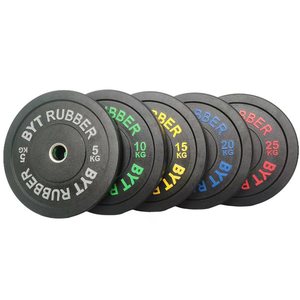
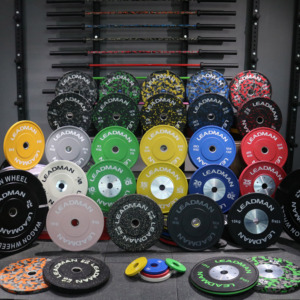
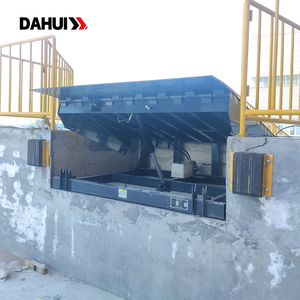
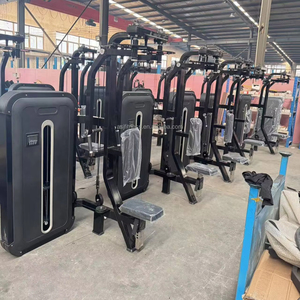
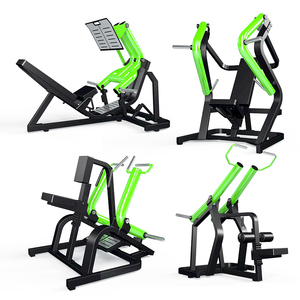
Explore our engineered commercial catalog ranging from high-density rubber bumper plates and synthetic turf sprint tracks to pin-loaded bio-mechanical equipment and structural dock ramps.
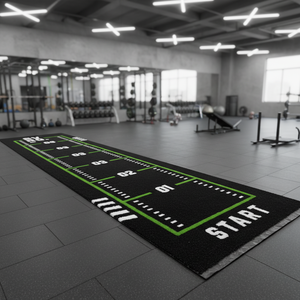
In modern commercial fitness facility engineering, flooring is no longer treated as a passive surface covering. It represents a critical structural component responsible for kinetic shock attenuation, acoustic dampening, subfloor structural preservation, and athlete safety. As specialized custom OEM gym rubber flooring manufacturers and global exporters, our engineering focus centers on high-density vulcanized rubber compounding, precision-molded polymer matrices, and multi-tier acoustic isolation.
Commercial gyms, cross-training boxes, Olympic weightlifting facilities, and multi-story commercial fitness centers present complex physical challenges. Heavy free-weight drops generate destructive kinetic energy pulses capable of micro-fracturing concrete slabs and transmitting low-frequency structure-borne vibration throughout building envelopes. To counter these forces, enterprise procurement teams are increasingly specifying high-density Styrene-Butadiene Rubber (SBR) bases coupled with high-percentage Ethylene Propylene Diene Monomer (EPDM) wear layers.
Technical Insight for Procurement Directors: Standard non-vulcanized rubber tiles often degrade under sustained shear force and heavy impact drops, leading to edge-curling, granule shedding, and VOC off-gassing. Advanced hot-press vulcanization technology locks elastomer chains into a dense, non-porous structure that delivers superior tensile strength (>5.2 MPa) and ultra-low chemical emissions.
The mechanical performance of commercial fitness rubber tiles depends directly on polymer composition, particle sizing, and polyurethane binder ratios. Our manufacturing lines utilize raw materials subjected to strict gravimetric sorting to ensure consistent volumetric mass density across every production batch:
| Performance Parameter | Recycled SBR Standard Tiles | Dual-Layer SBR + EPDM Fleck | High-Density Vulcanized Virgin Rubber |
|---|---|---|---|
| Volumetric Density | 800 – 880 kg/m³ | 920 – 980 kg/m³ | 1,100 – 1,250 kg/m³ |
| Shore A Hardness | 55° – 65° Shore A | 65° – 72° Shore A | 75° – 85° Shore A |
| Tensile Strength (ISO 37) | 2.1 – 3.2 MPa | 4.5 – 5.8 MPa | > 7.5 MPa |
| Force Reduction (EN 14904) | 32% – 40% | 45% – 58% | 60% – 68% |
| Acoustic Isolation (ΔLw) | 18 – 24 dB | 28 – 35 dB | up to 48 dB (with pedestal sub-system) |
| Chemical / VOC Standard | Basic Commercial Grade | REACH / SVHC Compliant | FloorScore® Certified Zero-VOC |
The global commercial fitness equipment and flooring market is undergoing a structural transition driven by urban multi-tenant zoning laws, corporate sustainability mandates, and specialized athletic training modalities. Global importers, OEM buyers, and fitness chain developers must align their supply chain specifications with these four macro trends:
Over the past decade, rubber flooring manufacturing has evolved from basic tire-shred pressing to precision polymer physics. As a dedicated OEM/ODM manufacturer, our R&D facility focuses on resolving the inherent tradeoffs between surface hardness, elasticity, and chemical stability.
Traditional cold-mold pressing relies heavily on chemical adhesives, resulting in variable density and internal void pockets. Advanced OEM production lines utilize continuous high-pressure thermal vulcanization presses operating at temperatures up to 200°C and hydraulic pressures exceeding 15 MPa. This thermal process forms irreversible cross-links between sulfur molecules and rubber polymer chains, yielding a uniform density profile from top surface to bottom base.
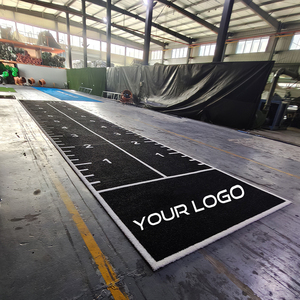
Generic screen-printed logos wear off under heavy foot traffic and sled friction within months. Modern OEM buyers utilize CNC laser inlay cutting combined with hot-press vulcanization. EPDM color flecks, meter markings for sprint tracks, brand emblems, and custom functional training zone lines are cut directly into the rubber substrate and thermally fused during production, establishing lifetime permanent branding.
Unsealed porous rubber flooring traps dust, chalk, moisture, and bacteria, making hygiene maintenance difficult for commercial gym operators. Our proprietary polyurethane surface sealing treatment creates a micro-barrier over the top granule layer. This technology prevents liquid absorption, provides UV stability to resist discoloration, and reduces maintenance cleaning labor by over 40%.
Operating from specialized manufacturing complexes equipped with advanced mixing banburys, automated rolling mills, and continuous vulcanization presses, our enterprise handles full-scope OEM and ODM requirements for commercial fitness brands, international distributors, and large-scale facility developers.
Key technical and logistical questions answered by our engineering and export team for international buyers, gym operators, and equipment distributors.